
Linux File Replication Software — Real-Time, Cross-Platform Sync for Windows & UNIX
Selected and deployed by the U.S. Department of Defense and the Social Security Administration following agency evaluations.
Byte-level delta replication. Bidirectional, one-to-many, and many-to-one topologies. AES-256 encryption and TLS 1.3 in transit.
A fast, auditable, C-native engine built for organizations managing infrastructure at scale.
EDpCloud is built for enterprises and government agencies. It is not designed or licensed for home or personal use.
References to U.S. government agencies on this website are for the purpose of identifying customers and do not imply endorsement by the U.S. government.
Trusted in the Most Demanding Environments
EDpCloud protects and moves data for federal agencies, healthcare providers, financial institutions, and global media organizations — environments where "it mostly works" isn't an acceptable standard.
Federal & Defense:
- U.S. Department of Defense
- Social Security Administration
- US Railroad Retirement Board
Healthcare:
- Medicaid
- Medicare, and large healthcare providers and insurers managing regulated patient data
How EDpCloud Works
Replication Performance Depends on More Than Bandwidth
- Delta transfers. Replicating only the changed portion of a file — rather than the whole file — reduces data transferred, improves bandwidth utilization, lowers destination storage requirements, and shortens the vulnerability window between when data changes and when it's protected.
- Parallel streams and throttling. The right balance of concurrent replication jobs and parallel transport streams matters — too many can cause network or disk contention, too few underuse available bandwidth. EDpCloud lets you tune this rather than accepting a fixed default.
- Name resolution reliability. DNS resolution time and reliability directly affect how quickly replication connections can be established, especially across multiple subnets or geographically distributed sites — a factor that's easy to overlook until it becomes a bottleneck.
- Storage and file system overhead. Read/write speeds on both source and destination, along with I/O block sizes, influence throughput independent of network conditions.
- Encryption overhead. Security measures like encryption protect data in transit but introduce processing overhead — EDpCloud is engineered to keep that cost low rather than treating security and performance as a trade-off you have to accept.
1. Install and Configure
2. Monitor and Replicate in Real Time
3. Verify, Manage, and Recover Automatically
Built-in checkpoint/restart means interrupted transfers resume automatically rather than starting over. edverify confirms data integrity, edstat reports synchronization status, and edjob lists, cancels, prioritizes, or resets failed jobs. edalerts.cfg configures alerting so your team knows about problems before they become incidents.
Linux Data Replication: Built for Heterogeneous, Regulated Infrastructure
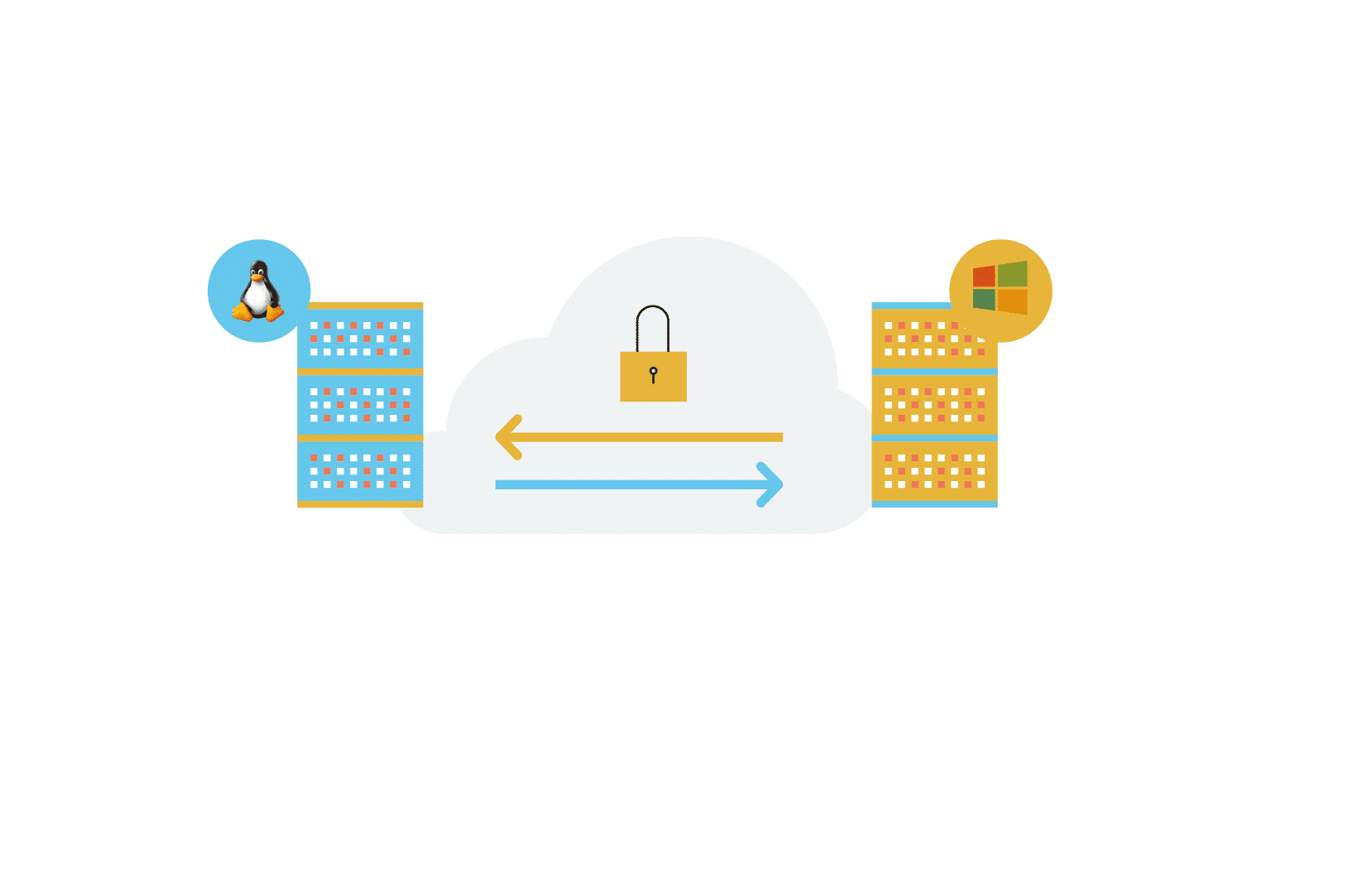
Platforms: Linux (RHEL, Debian, Ubuntu), Windows Server, AIX, Solaris, FreeBSD, OpenBSD, macOS
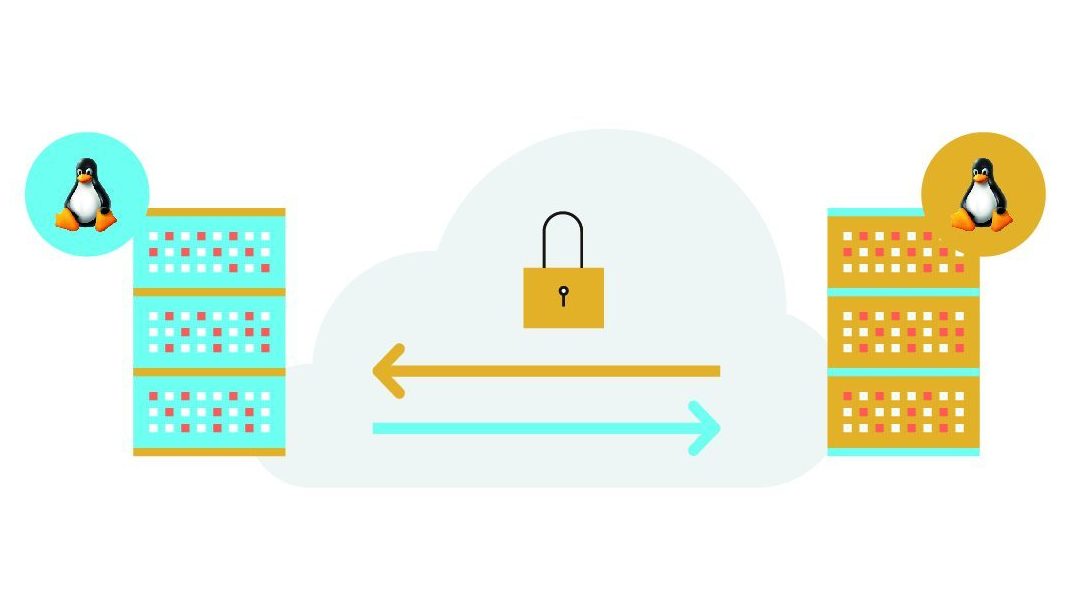
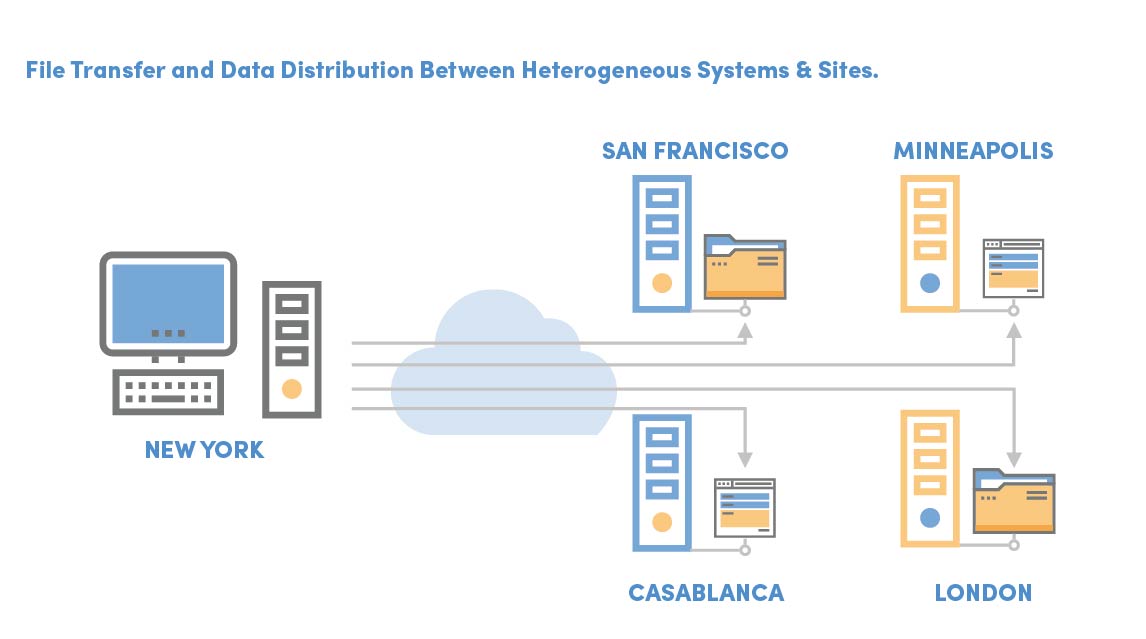
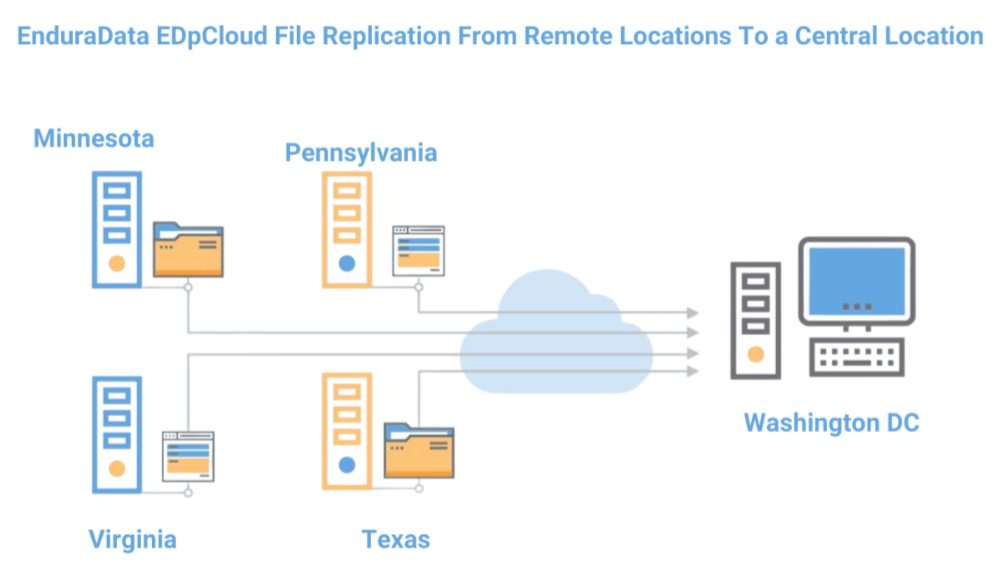
Topologies: Bidirectional (multi-master), one-to-many (fan-out), many-to-one (aggregation)
Security: AES-256 encryption, TLS 1.3 in transit, Section 889 compliant
Bandwidth-constrained links: Built for high-latency, unstable, and satellite/DDIL (Denied, Degraded, Intermittent, and Limited/Low-Bandwidth) environments.
Architecture: Written in C and optimized natively for each platform it runs on, with a minimal footprint on every supported operating system
On Linux specifically, EDpCloud's real-time file system monitor works on the same underlying principle as the kernel's own inotify and fanotify subsystems —watching directories for changes and replicating only what's changed, immediately.
Replication Topologies: Choose the Shape That Fits Your Infrastructure
Not every environment needs to move data the same way. EDpCloud supports three core topologies, and most customers combine more than one across their infrastructure:
a. Bidirectional (Multi-Master)
b. One-to-Many (Fan-Out)
c. Many-to-One (Aggregation)
Security & Compliance
Common Use Cases of File Replication and Synchronization
1. Replacing RepliWeb or Attunity for Data Protection
2. Disaster Recovery & Business Continuity
Real-time, byte-level replication keeps a current copy of your data ready at a secondary site, reducing recovery time when something goes wrong. Documented DR/BCP runbooks support formal RTO/RPO planning.
3. Ransomware Tolerance
EDpCloud is built on defense-in-depth principles: secure defaults, least-privilege operation, and verifiable data integrity across every replication path.
Encryption in transit: TLS-protected channels with modern cipher suites
Encryption at rest: Encrypted repositories and credential protection
Access & identity: Role-based access controls, separation of duties, minimal credentials on endpoints, key rotation guidance
Logging & audit: Structured, audit-friendly logging and event streams for SIEM ingestion
Disaster recovery: Replication policies and documented DR/BCP runbooks
Vulnerability management: SBOM (Software Bill of Materials) and security advisories with each significant release
EDpCloud fits into zero-trust architectures using scoped credentials, policy-based segmentation, and mutual TLS where applicable. Full documentation — including a security brief, SBOM, hardening checklists, and logging integration notes — is available on request: see the full security & compliance overview.
4. Regulated Industry Compliance
Built-in encryption, role-based access control, structured audit logging, and Section 889 compliance support the needs of federal, healthcare, and financial services environments.
5. Data Aggregation, Distribution & Ingestion
Why Teams Chose EnduraData EDpCloud
System administrators testimonials
"EDpCloud works perfectly and seamlessly in our environment. With so much data to replicate, this product is efficient and it is hard to realize that it there doing its job in the background. If you ever need EnduraData's support, they are always there if you need any assistance. They are prompt and talented. I highly recommend EDpCloud and EnduraData for anyone looking for real time file replication and file mirroring."
"This is the first time that we were able to complete the synchronization of over two terabytes of data and over two and a half million files back and forth daily between the two countries. EnduraData's support was very helpful in assisting us with configuring and getting the project finished on time and under budget."
"EnduraData's software performed very well. EnduraData engineers went above and beyond to assist our company whenever we needed them. As always, they are very responsive. I am very satisfied with their work."
"Support helped us solve integration issues quickly and professionally. EDpCloud is rock solid and its performance is outstanding."
See EDpCloud in Action
Watch a brief overview of how EDpCloud solves real-time, cross-platform replication challenges, plus the Social Security Administration's story of modernizing Linux file replication with EDpCloud.